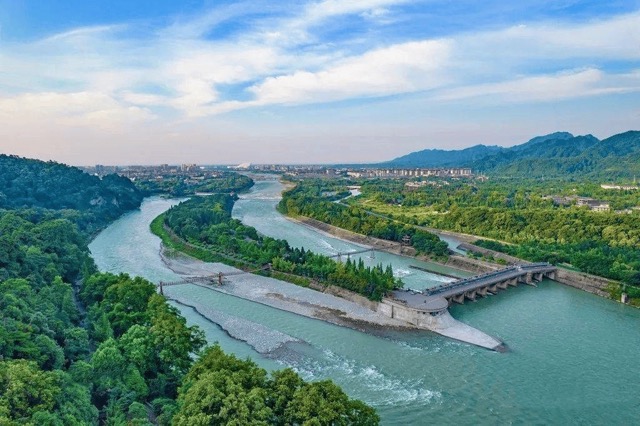
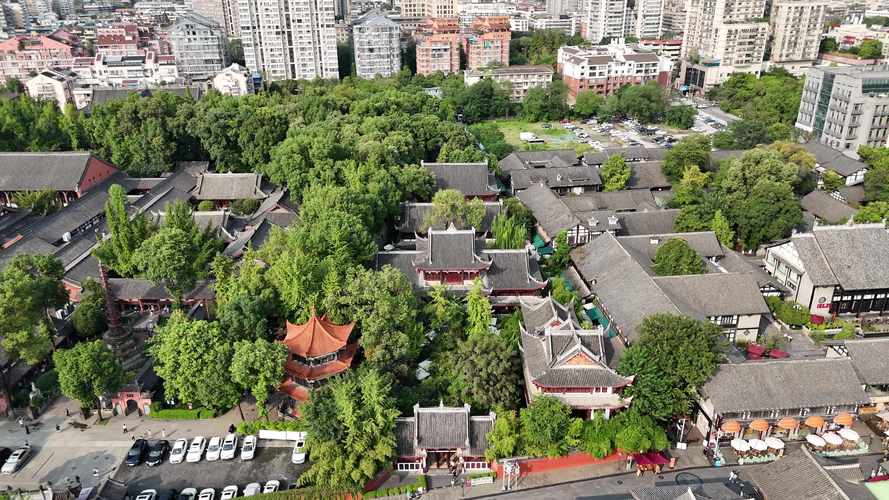
Aerial panorama of the Dujiangyan irrigation system and the Min River
Home Destinations Travel Guides Booking Services About Us

Dujiangyan Irrigation System (都江堰)

Four water works built in 256 BC that still irrigate the Chengdu plain — the Fish Mouth, the Flying Sand Weir, the Bottle-Neck Channel and the Anlan Suspension Bridge

Dujiangyan Guide

If you need car charter or ticket booking services, please click Booking Page

Dujiangyan Overview

A water system built 2,280 years ago that still waters the Chengdu plain — no dam, no cement, just the shape of the river, and the reason this city has rice, tea and silk at all.

Li Bing (李冰), governor of Shu around 256 BC, did not dam the Min River — he split it. The channel that used to flood Chengdu now irrigates it, and the plain behind it became the “land of abundance” (天府之国). The works have been repaired many times in 2,280 years but never redesigned, which is why UNESCO listed the site in 2000.

The route is simple: enter at the main gate, walk downstream to the three water works, cross the Anlan Suspension Bridge, and leave by the south gate — about 3-4 hours, mostly flat and shaded. Come early; the tour buses from Chengdu arrive around ten.

4
Core Works
¥80
Adult Ticket
3-4 h
For the Whole Site
Aerial panorama of the Dujiangyan irrigation system and the Min River
Dujiangyan City
8:00 - 18:00
¥80 entry
3 - 4 hours

The Four Core Works

This is also the order you meet them walking downstream — no backtracking.

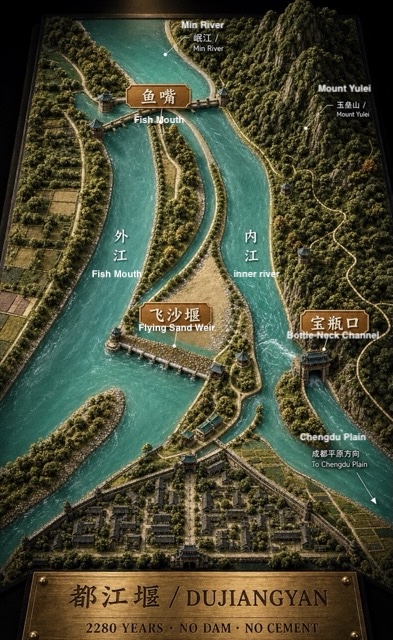
  • Fish Mouth (鱼嘴): The heart of the system — an artificial island sitting in the middle of the Min River (岷江) that splits the water into an inner river (内江) for Chengdu and an outer river (外江) for the floods. In the dry season most water goes to Chengdu, in flood season most goes to the outer channel, and the shape does it with no gate at all.
  • Flying Sand Weir (飞沙堰): Just downstream, this low weir spills the surplus flood water and throws the silt out of the inner river. It is the safety valve of the whole system, and the reason the inner channel has stayed clear for two thousand years.
  • Bottle-Neck Channel (宝瓶口): Near Fulong Temple (伏龙观), a channel cut by hand through the end of Mount Yulei (玉垒山) and shaped like a bottle neck. Its width sets how much water can enter the Chengdu Plain (成都平原): too wide and Chengdu floods, too narrow and the rice fails.
  • Anlan Suspension Bridge (安澜索桥): The iron-chain bridge over the Min River, linking the two banks and swaying under every step. The best photo spot on the site and the most fun fifty metres of the walk — hold the ropes and go one at a time.

Detailed Information

Location

Park Road, Dujiangyan City, Chengdu — main gate near the South Bridge

Opening Hours
  • 8:00 - 18:00 from March to November
  • 8:00 - 17:30 in winter, last entry 30 minutes before closing
  • Open every day of the year
Best Time to Visit

Weekday morning before ten, when the site is quiet and the light is soft

June to September brings more water in the Min River — the Fish Mouth is at its most dramatic

Tickets & Prices

¥80 per adult; half price for students and seniors with ID

Sightseeing carts and the cable car at Erwang Temple (二王庙) are extra; combo tickets with Mount Qingcheng are sold at the gate

Reservation Information
  • No timed booking needed — buy at the gate or on WeChat / Meituan
  • Bring your passport; tickets are checked against the ID used to buy them
  • Book a guide at the visitor centre if you want the engineering explained
Transportation
  • High-speed train from Chengdu Xipu station to Dujiangyan station, about 35 minutes
  • From the station, 10 minutes by taxi to the main gate near the South Bridge
  • Same line continues to Mount Qingcheng — easy to pair both in one day

Expert Guides

Discover our comprehensive travel guides for Chengdu

Dujiangyan Community Posts

Share your photos of the Fish Mouth, the weir and the suspension bridge with other travellers, and swap tips on trains from Chengdu.


Loading posts...